The Partition Prequel: A Nation Born of a Tantrum
In the sultry summer of 1947, the Indian subcontinent was sliced like a poorly cut birthday cake, with the British Raj playing the clumsy baker. The Pakistan Movement, fueled by the All-India Muslim League and its suave leader Muhammad Ali Jinnah, insisted that Muslims needed their own sandbox to avoid sharing toys with the Hindu majority. The Two-Nation Theory, a brainchild of Sir Syed Ahmad Khan and later polished by poet-philosopher Muhammad Iqbal, argued that Muslims and Hindus were as compatible as oil and water—or, more aptly, biryani and sushi. The Lahore Resolution of 1940 sealed the deal, demanding a separate state for Muslims where they could pray, eat beef, and govern without the looming shadow of Congress’s secular sermonizing.
But here’s the kicker: the loudest voices for Pakistan didn’t come from the dusty plains of Punjab or the bustling bazaars of Sindh. They echoed from the elite drawing rooms of Uttar Pradesh (U.P.) and Bombay, where Urdu-speaking, well-heeled Muslims—known later as Muhajirs—dreamed of a utopia they’d rule like feudal lords. These were the aristocrats, merchants, and intellectuals who saw Pakistan not just as a homeland but as a blank canvas for their ambitions. Little did anyone know, they’d paint it, frame it, and then jet off to London or Dubai with the proceeds.
The Great Migration: Suitcases Stuffed with Dreams (and Gold)
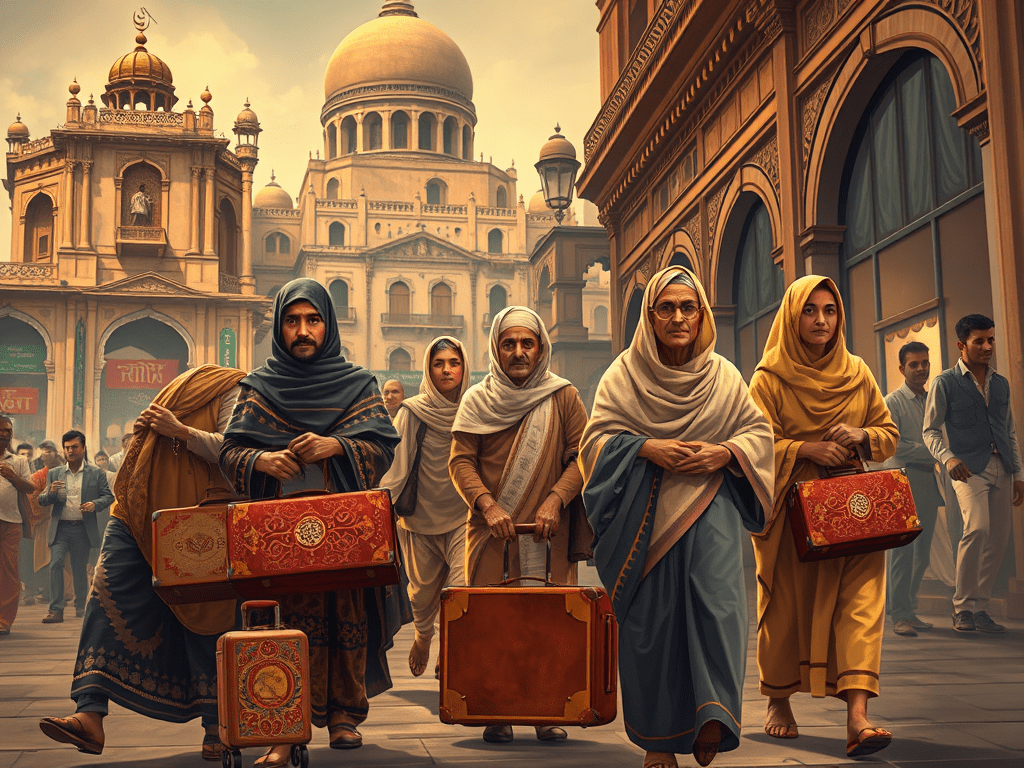
When the Radcliffe Line was drawn—by a British lawyer who’d never set foot in India—chaos erupted. Over 15 million people were uprooted in what became the largest mass migration in history, with blood-soaked trains and bullock carts carrying tales of horror. Among this human tide were the creme de la creme of Muslim society from India’s urban centers. These weren’t your average farmers clutching a single sack of rice. These were families with sprawling havelis in Lucknow, textile empires in Bombay, and law degrees from Aligarh Muslim University. They arrived in Karachi and Lahore with trunks of silk, jewelry, and a peculiar sense of entitlement.
Take the example of the Ispahani family, wealthy traders from Calcutta who relocated to Karachi and quickly became industrial titans in Pakistan’s nascent economy. Or consider Liaquat Ali Khan, Pakistan’s first prime minister, a U.P. aristocrat whose Oxford education and polished Urdu made him the poster boy for the Muhajir elite. These migrants didn’t just bring their wealth; they brought a mindset: Pakistan was their project, a nation to mold in their image, not a home to sink roots into.
Interesting Fact: Karachi, Pakistan’s first capital, was 47.6% Hindu in 1941 but became overwhelmingly Muslim by 1948 as Muhajirs flooded in, turning it into their political and cultural stronghold. Meanwhile, Delhi lost a third of its Muslim population, including many who’d later shape Pakistan’s identity.
The Cultural Coup: Urdu Over Everything
The Muhajirs didn’t just take over Pakistan’s politics; they staged a cultural heist. Urdu, a language spoken by only 8% of Pakistan’s population at independence, was declared the national tongue, sidelining Punjabi, Sindhi, and Pashto. Why? Because Urdu was the language of the Muhajir elite, the tongue of Ghalib’s poetry and their Aligarh-educated bureaucracy. It was as if they said, “If we’re running this show, everyone’s speaking our script.”
This linguistic imperialism wasn’t just about communication; it was about identity. The Muhajirs framed Urdu as the glue of Pakistan’s Islamic identity, conveniently ignoring that most Pakistanis prayed in Punjabi or gossiped in Sindhi. Schools, government offices, and media were flooded with Urdu, creating a cultural hierarchy where the Muhajir way of life—urban, refined, and suspiciously Delhi-esque—was the gold standard. Native Sindhis and Punjabis grumbled, but the Muhajirs had the pens, the podiums, and the power.
Short Example: The Muhajir-dominated Muttahida Qaumi Movement (MQM) in Karachi has long championed Urdu and Muhajir identity, often clashing with Sindhi nationalists who feel their culture was hijacked by outsiders. Even today, Karachi’s political scene is a tug-of-war between Muhajir elites and local Sindhis.
Political Power Grab: The Elite’s Playground
Pakistan’s early years were a masterclass in Muhajir domination. The Muslim League, packed with U.P. and Bombay migrants, became the country’s default ruling party. Bureaucrats like Ghulam Muhammad, a Punjabi but cut from the same elite cloth, and Liaquat Ali Khan ensured that power stayed in the hands of those who’d crossed the border with polished shoes and sharper ambitions. By 1953, when Prime Minister Khawaja Nazimuddin was sacked by Governor-General Ghulam Muhammad, it was clear: the Muhajir-heavy bureaucracy, not the electorate, called the shots.
This wasn’t governance; it was a takeover. The Muhajirs and their allies built a system where politicians and bureaucrats operated like colonial viceroys, answerable to no one but themselves. Corruption became the grease in the wheels of power. Jinnah himself lamented this in a 1945 letter, calling the educated Muslim elite “selfish and morally and intellectually corrupt.” Yet, these were the same folks running Pakistan, and they ran it like a business they planned to sell.
Interesting Fact: The 1956 Constitution, crafted by Muhajir-influenced bureaucrats, declared Pakistan an Islamic Republic but conveniently ignored regional demands for autonomy, setting the stage for East Pakistan’s eventual secession as Bangladesh.
The Dual-Passport Escape Plan
Here’s where the satire bites hardest: the Muhajirs and their descendants never fully committed to Pakistan. They built it, ruled it, and then—when the going got tough or the bank accounts got fat—they bolted. Dual passports became their golden parachutes. London, Dubai, and Toronto are littered with Pakistani politicians and bureaucrats who treat Pakistan like a summer home.
Take Nawaz Sharif, the PML-N leader and multiple-time prime minister. His family’s sprawling business empire spans Pakistan and the UK, with plush apartments in London’s Mayfair. When corruption scandals hit, Sharif conveniently finds himself abroad, sipping tea in exile. Or consider Pervez Musharraf, the former military dictator, who fled to Dubai after his tenure, citing “medical reasons” while Pakistan grappled with his legacy. These aren’t exceptions; they’re the rule.
The mindset is clear: Pakistan is a project, not a home. The Muhajir elite, and later their Punjabi and Sindhi counterparts who adopted the same playbook, see themselves as global citizens, not tethered to the nation they shaped. Their children study at Oxford, their wealth sits in offshore accounts, and their loyalty is as flexible as their passports. Meanwhile, the average Pakistani, rooted in the soil of Punjab or Balochistan, wonders why their leaders always have one foot out the door.
Short Example: In 2010, Transparency International reported that Pakistan’s elite—politicians, bureaucrats, and businessmen—siphoned billions through corruption, often funneling it abroad. The Panama Papers later exposed dozens of Pakistani elites, including Sharif’s family, with offshore accounts.
The Identity Crisis: A Nation Adrift
Pakistan’s identity is a patchwork quilt, and the Muhajirs sewed it with threads of their own making. They pushed an Islamic, Urdu-centric narrative that alienated regional cultures—Punjabi, Sindhi, Baloch, and Pashtun. The result? A nation that doesn’t quite know what it is. Is it the land of the Indus Valley, with 5,000 years of history? Or a shiny new Islamic state, as the Muhajirs envisioned? The elite’s refusal to embrace Pakistan’s diverse roots has left it culturally adrift, with leaders who’d rather identify with London’s skyline than Lahore’s minarets.
Interesting Fact: Pakistan’s military, the country’s most powerful institution, benefits from this identity crisis. By keeping tensions with India alive (thank you, Kashmir), it justifies its dominance, while the Muhajir-descended civilian elite play along, happy to profit from the chaos.
The Satirical Sting: A Nation for Sale
So here we are, in 2025, watching Pakistan’s elite treat their country like a Airbnb rental—use it, abuse it, then leave a bad review on the way out. The Muhajirs who broke India to build Pakistan didn’t just migrate; they colonized, imposing their language, politics, and transient loyalties on a land they never fully embraced. Their dual passports are less a safety net than a confession: they don’t belong, and they never did.
The irony is delicious. The same folks who preached the Two-Nation Theory, who insisted Muslims needed their own state, are the first to jump ship when the state they built starts creaking. Pakistan, in their hands, is less a nation than a get-rich-quick scheme, with the exit strategy always in the fine print. As for the rest of Pakistan—those who stayed, who speak Punjabi or Sindhi, who can’t afford a second passport—they’re left to clean up the mess, wondering why their leaders keep checking out before the bill arrives.


Leave a comment