Every generation believes its wars are unique. Politicians blame borders, ideology, religion, or security threats. News channels frame conflicts as reactions to immediate events. But when you zoom out across a century, a strange pattern begins to appear — one that rarely enters public conversation.
Wars may not start because nations want to fight. They often start because global systems periodically reach a point where conflict becomes the only mechanism powerful enough to reset them.
The Hidden Engine: Systemic Reset
Large wars historically appear when three pressures converge:
- Unsustainable economic structures
- Technological shifts that disrupt power balance
- A declining global order losing legitimacy
When these forces collide, the existing system cannot adapt fast enough. War becomes the brutal but effective tool that forces a reset.
History shows this clearly.
World War I: The Collapse of the Old Industrial Order
By 1914 the world had:
- Massive industrial overproduction
- Colonial competition for resources
- Financial systems stretched by imperial expansion
- Military technology (machine guns, artillery, rail mobilization) far ahead of political diplomacy
The assassination of Archduke Franz Ferdinand was merely the spark.
The powder keg was already built by economic and technological imbalance.
WWI destroyed empires, redrew maps, and restructured finance.
World War II: The Reset of a Broken Post-WWI System
The Treaty of Versailles created economic humiliation and instability. Add to that:
- The Great Depression
- Rapid militarization technologies (tanks, aircraft, radio coordination)
- Ideological mass mobilization
The world order created after WWI could not sustain itself.
WWII reset it again — leading to the U.S.-led global system, the UN, NATO, Bretton Woods institutions, and a new economic architecture.
The Pattern Few People Talk About
Large conflicts historically occur when three global cycles overlap:
- Debt cycles peak (global financial strain)
- Power transition cycles (a rising power challenges an established one)
- Technological revolutions (new military or economic technologies)
Right now, all three are happening simultaneously.
- Global debt is at historic highs.
- Power is shifting from a single-superpower world toward multipolar competition.
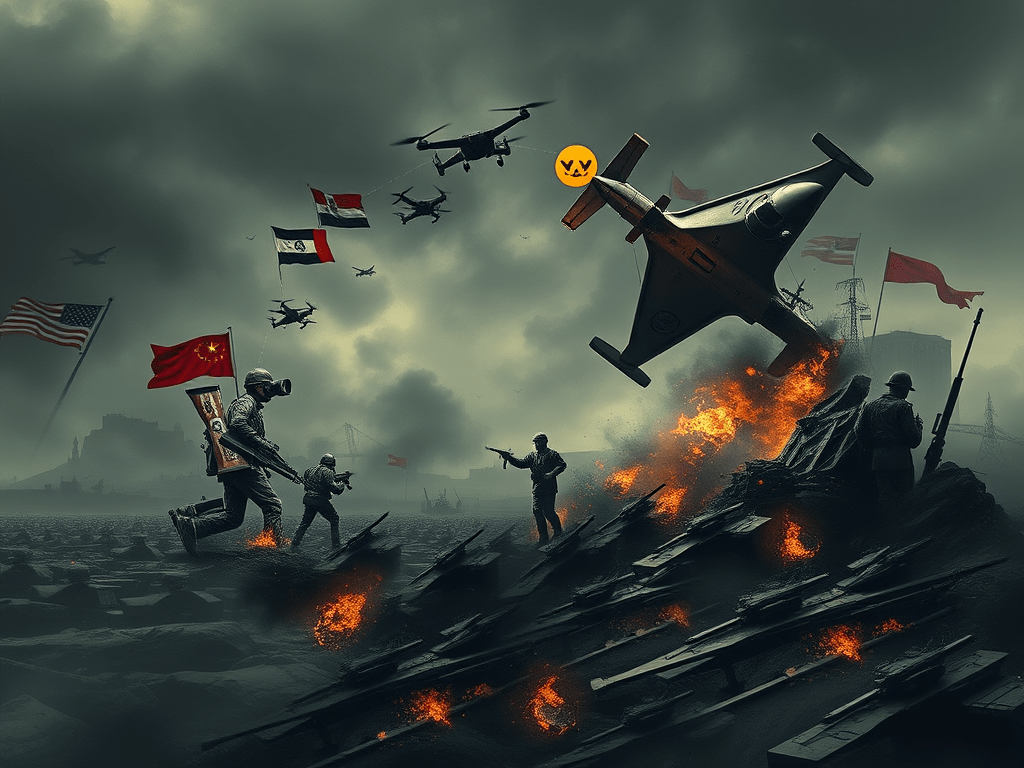
- AI, drones, cyber warfare, and autonomous weapons are redefining combat.
This is not how wars start.
This is how the conditions for systemic war emerge.
The Strange Echo of the Early 1900s
The early 20th century looked eerily similar to today:
| Early 1900s | Today |
| Rapid globalization | Globalized economy |
| New disruptive technology (industrial war) | AI, cyber, autonomous warfare |
| Rising powers (Germany vs Britain) | Rising powers challenging existing order |
| Financial instability | Global debt crisis |
| Regional conflicts escalating | Proxy wars across multiple regions |
In both periods, most people believed a world war was unlikely — right until it happened.
The Real Conspiracy
The uncomfortable truth may not be that someone secretly plans world wars.
The deeper possibility is more unsettling:
Global systems may be structurally designed in a way that periodically requires catastrophic resets.
Political leaders argue over policies.
But the economic and geopolitical machinery underneath may already be moving toward collision.
In that sense, wars are not always accidents.
Sometimes they are symptoms of a system that has run out of peaceful ways to rebalance itself.
Are We Moving Toward Something Bigger?
Right now we see:
- Multiple simultaneous regional conflicts
- Military spending rising worldwide
- Strategic alliances hardening
- Supply chains splitting into geopolitical blocs
Historically, this stage often precedes a period of fragmentation before consolidation.
Whether that consolidation happens through cooperation — or conflict — is the question that will define the coming decade.
And history suggests one uncomfortable truth:
The world rarely changes its system without first breaking it.

Leave a comment