Why Matter, Molecules, Atoms, and Quarks Look Like Elements in Space
(And Are They All the Same in Different Dimensions?)
1. The Mystery We Ignore Every Day
Everything you touch — your hand, your phone, the air — is made of matter.
But what is matter?
When we look closer, it becomes molecules.
Closer still — atoms.
Then nucleus, protons, neutrons, electrons.
Go even deeper — quarks, gluons, and maybe, the vibrating strings beneath all creation.
Each step down feels like peeling a layer of the same onion.
The smaller we go, the more the universe seems to repeat itself — patterns, spins, forces, and balance.
Like echoes from another dimension.
2. The Cosmic Reflection
Look at the solar system — a bright sun in the center, planets revolving in perfect rhythm.
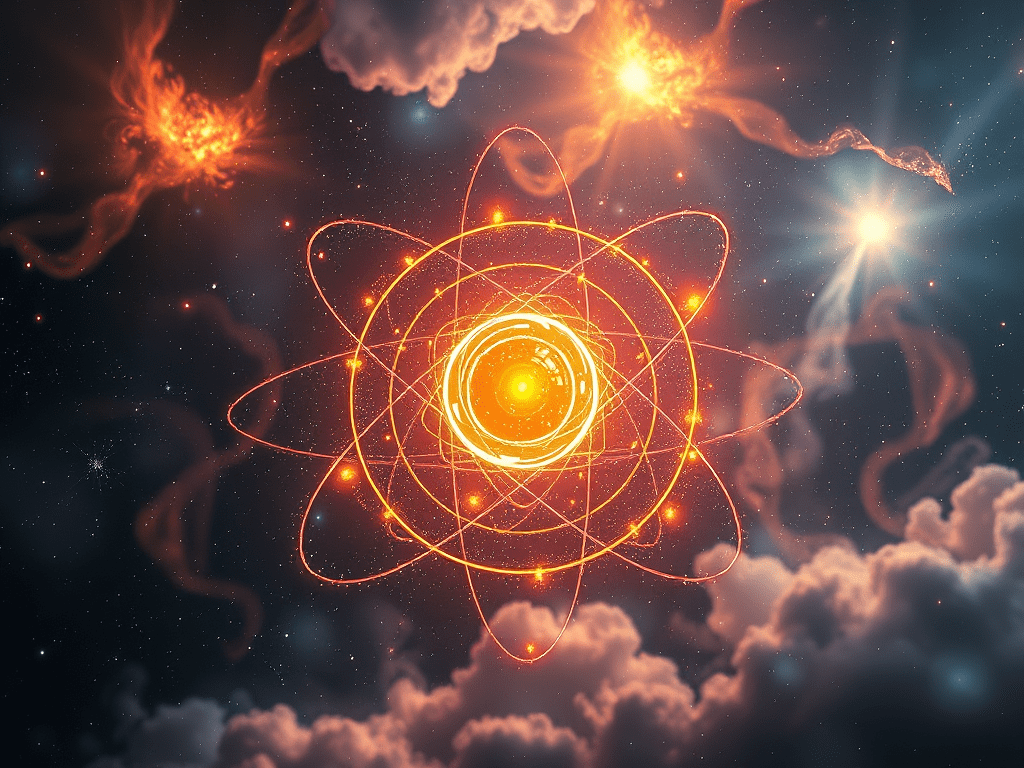
Now look at the atom — a bright nucleus in the center, electrons revolving in rhythm.
The structure is the same.
The scale is different.
Could it be that the atom is a miniature solar system, and the solar system is a giant atom in another dimension?
Science calls this a coincidence of pattern.
Vedic philosophy calls it “Brahmanda – the cosmic egg”, where what is inside is also outside.
In Sanskrit it is said:
“Yatha pinde tatha brahmande” —
“As is the atom, so is the cosmos.”
3. The Hidden Link of Energy
Physics tells us that energy cannot be created or destroyed, only transformed.
The Vedas said it thousands of years ago — “Naasya sṛṣṭir na vināśaḥ”,
there is no true birth or death, only change of form.
When we break down matter, we reach particles so small that they are not matter anymore, but pure vibration, pure energy.
Modern string theory says every particle — electron, quark, gluon — is just a tiny vibrating string.
Different vibrations make different particles —
like different notes of music make different sounds.
The Vedas describe this same idea as “Nāda Brahma” —
the Universe is sound.
Creation began with OM, the eternal vibration.
So what physicists call vibration, the Vedas call OM.
The same truth, spoken in different languages.
4. The Dark Space Within
Between every atom is empty space.
Between the nucleus and the electron — more emptiness than matter.
Yet this emptiness holds the universe together.
The Rig Veda called this “Shunyata” — the sacred void.
The place where nothing becomes everything.
Modern physics agrees:
Vacuum is not truly empty — it’s filled with virtual particles flashing in and out of existence.
Creation and destruction happening every fraction of a second —
an eternal dance of birth and death.
Isn’t that what life is too?
5. Dimensions Within Dimensions
What if the electron’s orbit is not just a path —
but a dimension we cannot perceive?
What if quarks are not the smallest —
but doorways to higher layers of existence, folded into the lower ones?
In Vedic cosmology, there are 14 Lokas (planes of existence).
From Bhuloka (our Earthly world)
to Satyaloka (the realm of pure consciousness).
Maybe, what science calls “subatomic” are just reflections of these planes —
each smaller particle not smaller in space,
but deeper in vibration.
An electron might be the shadow of a being that exists fully in a higher dimension.
A quark could be the heartbeat of a universe within us.
6. The Dark Unity
Every atom in your body was once part of a star.
When stars explode, they release the materials that become planets, trees, and humans.
So, the iron in your blood, the calcium in your bones, the oxygen you breathe —
were once glowing in a star’s heart.
Vedas said:
“Tat tvam asi” — You are That.
Science now whispers the same truth:
You are stardust.
The universe is not out there — it is you, folded inward.
7. The Final Thought: The Mirror of Creation
When you look up at the night sky,
you are not looking out —
you are looking in.
Every galaxy, every atom, every quark is a mirror of the same eternal design.
A single pattern repeating across infinite scales and dimensions.
Matter, molecule, atom, nucleus, quark —
they are not different things,
just different perspectives of the same cosmic being.
Call it energy,
call it Brahman,
call it the field,
call it the string —
it is One.
And this One, split across space and time,
pretends to be many —
just so it can know itself.
8. Conclusion
Modern science explores with equations.
Vedic wisdom explored with consciousness.
But both point to one mystery —
that everything, from the tiniest quark to the largest galaxy,
is part of a single living reality vibrating across dimensions.
The question is not what the universe is made of,
but who is dreaming it.

Leave a comment