Story Telling (Fiction)
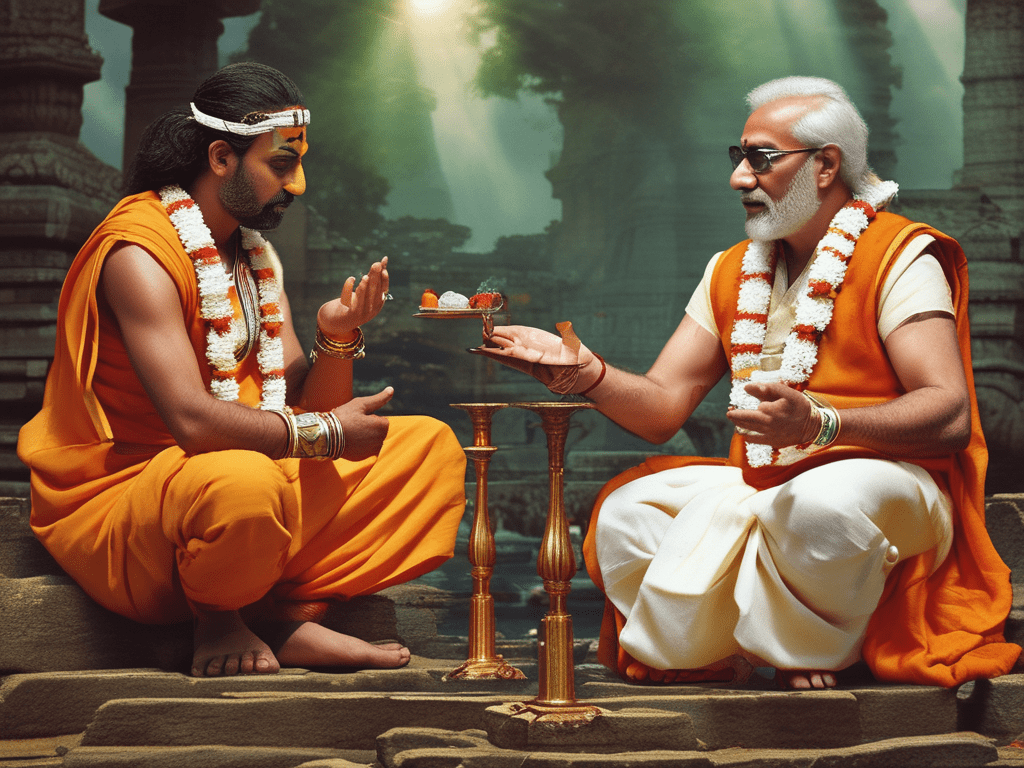
In the hallowed corridors of celestial realms, where time flows in a continuum that connects past, present, and future, an unusual dialogue unfolded between two figures that spanned centuries apart. Narendra Modi, the Prime Minister of India in the 21st century, found himself in the presence of Lord Rama, the legendary prince of Ayodhya from the ancient epic, the Ramayana. The setting was ethereal yet tangible, as they stood amidst the timeless echoes of history and destiny.
Act I: The Meeting of Minds
Narendra Modi stood respectfully before Lord Rama, feeling both awed and humbled by the presence of the divine figure who had guided countless souls through the epochs. The atmosphere was serene, yet charged with an undercurrent of anticipation.
Lord Rama, with his compassionate gaze, spoke first, his voice resonating with wisdom accumulated over millennia. “Narendra Modi, son of India, I have watched over the land that I once ruled. Tell me, what have you achieved in your tenure as the leader of this great nation?”
Modi gathered his thoughts, mindful of the weight of his words in the presence of such a revered figure. “My Lord Rama,” he began, “in the past decade, India has seen transformation on many fronts. We have made strides in infrastructure, technology, and economic growth. Our aim has been to uplift the lives of our citizens and bring prosperity to every corner of this diverse land.”
Lord Rama nodded thoughtfully. “Indeed, infrastructure and economic progress are crucial. However, tell me, how have you addressed the deeper issues that affect the soul of this nation? Have you upheld justice, righteousness, and the welfare of all, especially the marginalized?”
Modi felt the piercing gaze of Lord Rama, understanding that this encounter was not just about listing achievements but about reflecting on the true essence of governance. “My Lord,” he replied earnestly, “we have worked to empower the poor, provide healthcare, and ensure education reaches the remotest villages. Yet, there are challenges—social inequality, environmental concerns, and the need for greater unity amidst diversity.”
Act II: Reflections and Realizations
Lord Rama’s expression softened slightly, acknowledging the complexities of modern governance. “Narendra Modi, leader of millions, in your pursuit of progress, have you not forgotten the timeless values that sustain a nation—compassion, empathy, and integrity?”
Modi bowed his head, grappling with the question. “My Lord,” he confessed, “perhaps in the zeal to build a new India, we have at times overlooked the essence of humanity that transcends material achievements. We have focused on economic growth, but true development also means preserving our cultural heritage and fostering harmony among communities.”
Lord Rama’s eyes glinted with understanding. “You speak wisely, Narendra Modi. Remember, leadership is not merely about the tangible outcomes but also about the intangible values that bind a nation’s soul. As you look ahead, promise me this—prioritize the welfare of every citizen, safeguard justice and freedom, and protect the environment that sustains life itself.”
Modi nodded solemnly, his resolve deepening with each word spoken by Lord Rama. “I promise, my Lord, to lead with humility and to listen to the voices of all. I will strive not only for economic growth but also for social harmony and environmental sustainability. India’s progress must be inclusive, benefiting every individual regardless of caste, creed, or gender.”
Act III: Looking Towards the Future
As the conversation unfolded, time seemed to stand still in the celestial realm. Lord Rama imparted timeless wisdom, while Modi shared his vision for a vibrant and compassionate India. They discussed governance, policy-making, and the responsibilities of leadership in a rapidly changing world.
Lord Rama posed challenging questions on governance, justice, and ethical leadership, pushing Modi to confront the nuances of power and responsibility. Together, they explored the intricacies of development and the importance of preserving India’s rich cultural heritage amidst the whirlwind of globalization.
Modi, in turn, sought guidance on fostering unity in diversity and promoting peace in a region fraught with historical tensions. Lord Rama’s insights transcended time, offering profound clarity on the path forward for a nation at the crossroads of tradition and modernity.
Conclusion: A Call to Reflection and Action
As their conversation drew to a close, Narendra Modi bowed respectfully before Lord Rama, his heart filled with renewed purpose and determination. “My Lord,” he said with conviction, “I will carry your words with me as I continue to serve the people of India. Together, we will build a nation where every individual can flourish, where justice and compassion reign supreme, and where the spirit of unity prevails over division.”
Lord Rama smiled, his presence radiating warmth and reassurance. “Go forth, Narendra Modi,” he said, “and lead with courage and wisdom. Remember that true leadership is not about the tenure of power but about the legacy of service and the impact on generations to come.”
And so, Narendra Modi returned to the mortal realm, his mind ablaze with the insights gleaned from his encounter with Lord Rama. He knew that the journey ahead would be fraught with challenges, yet he carried with him the timeless wisdom of the ages—a beacon of hope and guidance for a nation striving towards a brighter future.
In the days that followed, discussions ignited across India—a dialogue not just about politics but about values, ethics, and the soul of a nation. People pondered the role of leadership, the impact of governance, and the responsibilities of citizens in shaping their collective destiny.
The encounter between Narendra Modi and Lord Rama transcended time and space, sparking a national discourse that resonated far beyond the realms of politics—a conversation that would shape the course of India’s journey for years to come.

Leave a comment