Time travel has long been a fascinating concept, capturing the imagination of scientists, writers, and dreamers alike. While it has been a staple in science fiction, what does actual science have to say about the possibility of traveling through time? Let’s delve into what researchers and physicists have theorized and discovered about this mind-bending idea.
Understanding Time: The Fourth Dimension
In our everyday experience, time seems to flow inexorably forward, and we are unable to change its course. According to Einstein’s theory of General Relativity, time is intertwined with space to form a four-dimensional continuum known as spacetime. This theory fundamentally altered our understanding of the universe, suggesting that time can be affected by gravity and the speed at which objects move.
Theoretical Frameworks
Several theoretical frameworks have been proposed that could potentially allow for time travel:
Wormholes: These are hypothetical tunnels through spacetime that could connect distant points in space as well as different times. While they are mathematically possible according to General Relativity, their stability and practicality remain highly uncertain.
Time Dilation: This phenomenon occurs due to differences in gravity or velocity, where time passes differently for objects moving at different speeds or experiencing different gravitational forces. For instance, astronauts on the International Space Station age slightly slower than people on Earth due to their higher velocity relative to the Earth’s surface.
Grandfather Paradox and Novikov Self-Consistency Principle: These concepts explore the logical implications of time travel. The grandfather paradox suggests that traveling back in time could alter events in a way that makes one’s own existence impossible. The Novikov self-consistency principle proposes that any actions taken in the past must be consistent with events that have already occurred, thus preventing paradoxes.
Experimental Efforts and Limitations
Despite theoretical possibilities, experimental verification of time travel remains elusive. The energy requirements for creating and stabilizing a traversable wormhole, for instance, are enormous and likely beyond our current technological capabilities. Moreover, the ethical and philosophical implications of altering past events raise significant questions about the feasibility and desirability of time travel.
While time travel remains firmly in the realm of science fiction and theoretical physics, there have been a few intriguing accounts and experiences that people have shared which hint at the possibility of encountering or experiencing time in unusual ways. Here are a couple of examples:
The Case of Rudolph Fentz:
One of the most famous supposed incidents of time travel involves a man named Rudolph Fentz. According to urban legend, Fentz appeared mysteriously in Times Square, New York City, in 1950. He was dressed in 19th-century clothing and seemed confused by his surroundings. Witnesses reportedly tried to help him, but moments later, Fentz was struck and killed by a car.
The story goes on to claim that authorities found identification on Fentz that indicated he lived in New York in the 1800s. However, further investigations by researchers and historians have revealed that the entire story is likely a work of fiction created by a writer named Jack Finney in his 1951 short story “I’m Scared.” Despite this, the tale of Rudolph Fentz continues to capture the imagination of those fascinated by the idea of accidental time travel.
The Time-Traveling Hipster Photograph:
Another intriguing modern-day example comes from a photograph taken in 1941 at the reopening of the South Forks Bridge in Gold Bridge, British Columbia. In the photograph, a man is seen wearing modern clothing—a printed t-shirt, sunglasses, and what appears to be a modern camera—among a crowd dressed in typical 1940s attire.
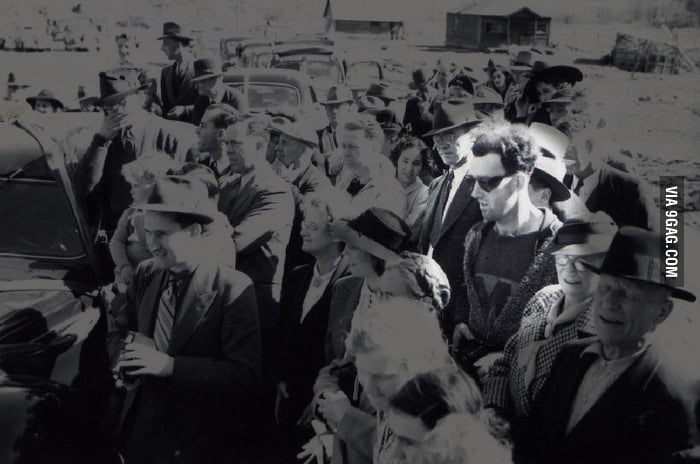
This photograph has sparked speculation and conspiracy theories suggesting that the man might be a time traveler who inadvertently ended up in the past. However, investigations into the photograph have suggested that the man’s clothing and accessories were not entirely out of place for the time period, albeit unusual for the rural setting.
Reflections on Time Travel Experiences:
These examples highlight how stories and anecdotes can captivate our imagination and make us wonder about the possibilities of time travel. While these particular instances have been debunked or are likely fictional, they illustrate humanity’s enduring fascination with the idea of transcending the boundaries of time.
In reality, our experiences of time are subjective and influenced by factors such as memory, perception, and cultural context. While science has yet to prove the feasibility of time travel as depicted in popular media, ongoing research into the nature of spacetime, quantum mechanics, and the theory of relativity continues to push the boundaries of our understanding.
Ultimately, whether through tales of supposed time travelers or through the lens of theoretical physics, the concept of time travel invites us to ponder profound questions about causality, existence, and the nature of reality itself. As we continue to explore these mysteries, the allure of time travel will likely persist, fueling both scientific inquiry and the imagination of generations to come.
While time travel continues to captivate scientists and the public imagination alike, it remains firmly in the realm of theoretical physics rather than practical reality. Current understanding suggests that while certain aspects of time manipulation are theoretically plausible, practical applications are far from being realized. As scientific knowledge advances and technologies evolve, our understanding of time and its potential manipulation may deepen, potentially uncovering new avenues for exploration.
In essence, while we may not be packing our bags for a journey to the past or future just yet, the ongoing pursuit of understanding time and its mysteries pushes the boundaries of human knowledge and serves as a testament to our insatiable curiosity about the universe we inhabit.
So, as we continue to gaze at the stars and ponder the nature of time itself, remember that the quest for understanding often sparks the most extraordinary discoveries, whether in the realms of science fiction or within the bounds of scientific inquiry. Time travel remains a tantalizing dream—one that science, with its relentless pursuit of truth, may one day help us realize.

Leave a comment