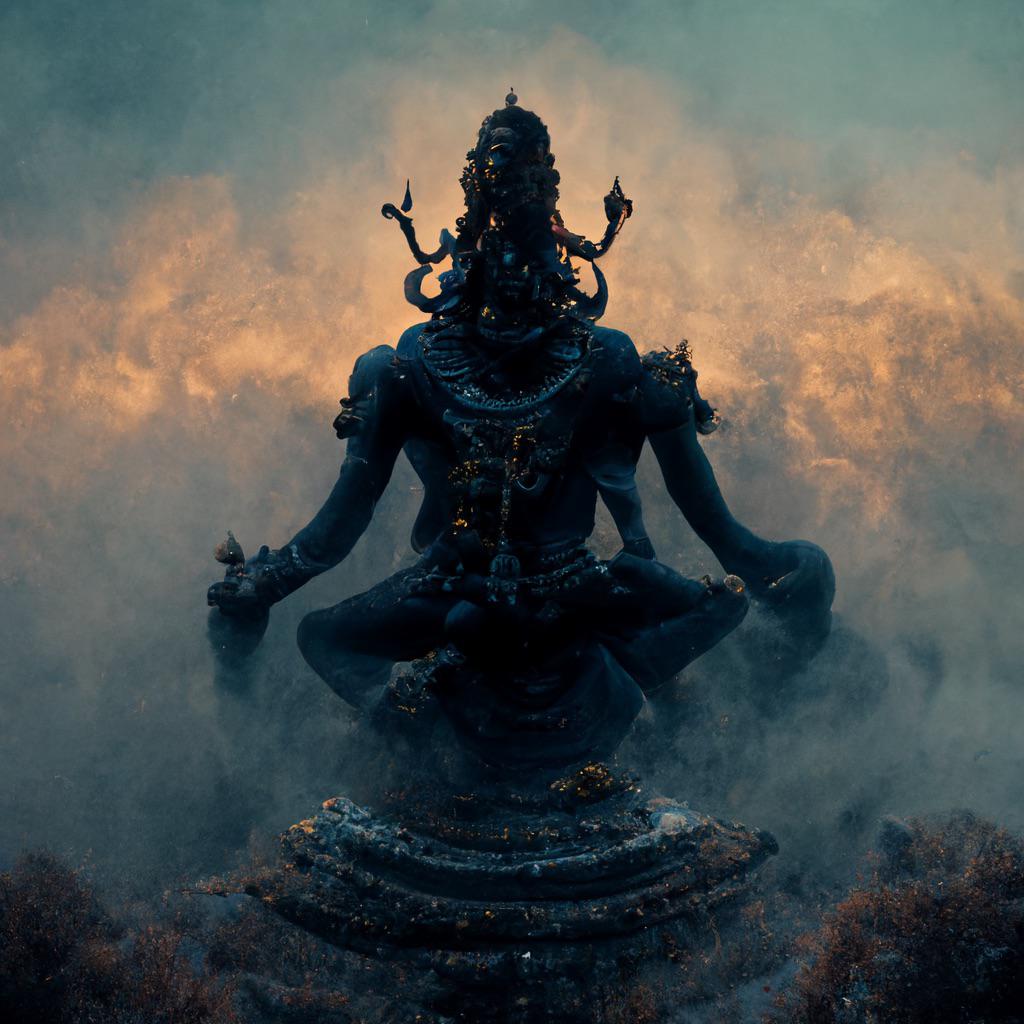
The Hindu deity Shiva is known as the god of destruction, transformation, and renewal. He is one of the principal deities in Hinduism, alongside Brahma and Vishnu, and is widely revered by Hindus all over the world. Shiva’s complex and multifaceted nature has inspired countless scholars, poets, and artists over the centuries, leading to a rich tradition of Shiva worship and devotion in Hinduism.
One of the most interesting and enigmatic aspects of Shiva is his association with both zero and infinity. In Hinduism, zero is a symbol of emptiness, nothingness, and transcendence, while infinity represents endlessness, limitlessness, and the unbounded nature of the universe. These two concepts seem to be diametrically opposed, and yet Shiva is said to embody both of them.
From a Vedic perspective, Shiva’s association with zero and infinity can be understood in several different ways. One interpretation is that Shiva represents the ultimate reality or Brahman, which is both transcendent and immanent. Brahman is considered to be the ultimate source and essence of all existence, and yet it is also beyond all concepts and definitions. In this sense, Brahman can be seen as both zero (nothingness) and infinity (the unbounded nature of the universe).
Another interpretation is that Shiva represents the two aspects of the cosmic cycle, creation and destruction. According to Hindu cosmology, the universe goes through a cycle of creation, preservation, and destruction, known as the “mahayuga”. Shiva is associated with the destruction or dissolution phase of this cycle, where all things are returned to their original state of emptiness and nothingness. This can be seen as a representation of zero.
At the same time, however, Shiva is also associated with the creative and generative aspects of the universe. In Hindu mythology, Shiva is said to have created the universe through his cosmic dance, known as the “tandava”. This dance represents the dynamic and ever-changing nature of the universe, and can be seen as a symbol of infinity.
Yet another interpretation of Shiva’s association with zero and infinity is that he represents the ultimate state of spiritual realization or enlightenment. In Hinduism, the goal of spiritual practice is to achieve moksha, or liberation from the cycle of birth and death. This state of liberation is often described as a state of oneness with the ultimate reality or Brahman, where all distinctions between self and other, subject and object, disappear. This state can be seen as both zero (the absence of all duality and differentiation) and infinity (the unbounded nature of the ultimate reality).
Shiva’s association with zero and infinity has also inspired many poets and artists over the centuries. In Hindu poetry, Shiva is often depicted as a wandering ascetic, meditating in the mountains or in the cremation grounds. These images are meant to convey the idea that Shiva is beyond all worldly concerns and attachments, and that he embodies the ultimate state of detachment and transcendence.
In art, Shiva is often depicted as dancing on the back of a demon, or as a cosmic dancer surrounded by flames. These images are meant to convey the dynamic and transformative nature of Shiva’s power, as well as his association with the cycle of creation and destruction.
In conclusion, the association of Shiva with zero and infinity is a complex and multifaceted aspect of Hinduism. From a Vedic perspective, Shiva represents the ultimate reality or Brahman, which is both transcendent and immanent, and which can be seen as both zero and infinity. Shiva’s association with these concepts has inspired countless poets, artists, and devotees over the centuries, and continues to be a source of inspiration and contemplation for Hindus

Leave a comment